Case study 01
Independent project · portfolio-safe demo
Odoo 18 Commerce Platform
Configured kits, customer pricing, product aliases, and end-to-end order flow
An independent Odoo 18 Community implementation demonstrating server-side price resolution, configurable kits, product aliases, and a consistent order flow using synthetic data only.
01 · Overview
Business context first, followed by the implementation choices that made the technical work meaningful.
The challenge
Configure complex kits, customer pricing, aliases, and quantity discounts without losing pricing accuracy or order-line identity across the sales workflow.
Ace’s role
Independent developer responsible for modeling the commerce rules, building the Odoo 18 Community implementation, and validating the handoff from shopper configuration to ERP documents.
Responsibilities
- Model pricing, product aliases, configured kits, inventory consumption, and order-line identity.
- Build and validate the website-to-ERP workflow with privacy-safe synthetic data.
- Keep customer-facing configuration constrained to validated options and server-resolved prices.
02 · The challenge
Constraints & risks
- 01Pricing must stay authoritative when customer-specific rules, quantity discounts, kits, and add-ons interact.
- 02Aliases need their own sellable SKUs and units of measure while consuming shared base inventory correctly.
- 03The portal must reveal only intended kit data while rejecting invalid option access and client-supplied prices.
Approach
- 01Model the storefront, cart, quotation, sales order, delivery, and invoice as one connected workflow.
- 02Resolve prices and validate configuration on the server instead of trusting browser state.
- 03Use representative synthetic scenarios to test rule precedence, shared inventory, and document continuity.
03 · Key technical decisions
Important choices, made visible.
Server-side pricing authority
The storefront requests a price, but Odoo evaluates the pricing hierarchy. Customer-specific rules and quantity discounts remain authoritative beyond the browser session.
Aliases share real inventory
An alias can carry a separate SKU and selling unit while its fulfillment demand is translated back to the shared base item, preventing a second inventory truth.
Portal-safe kit projection
A portal-access regression was resolved with a narrowly scoped, validated projection of only the kit data intentionally exposed to shoppers.
04 · What I built
End-to-end workflow
- 01
Configure in the storefront
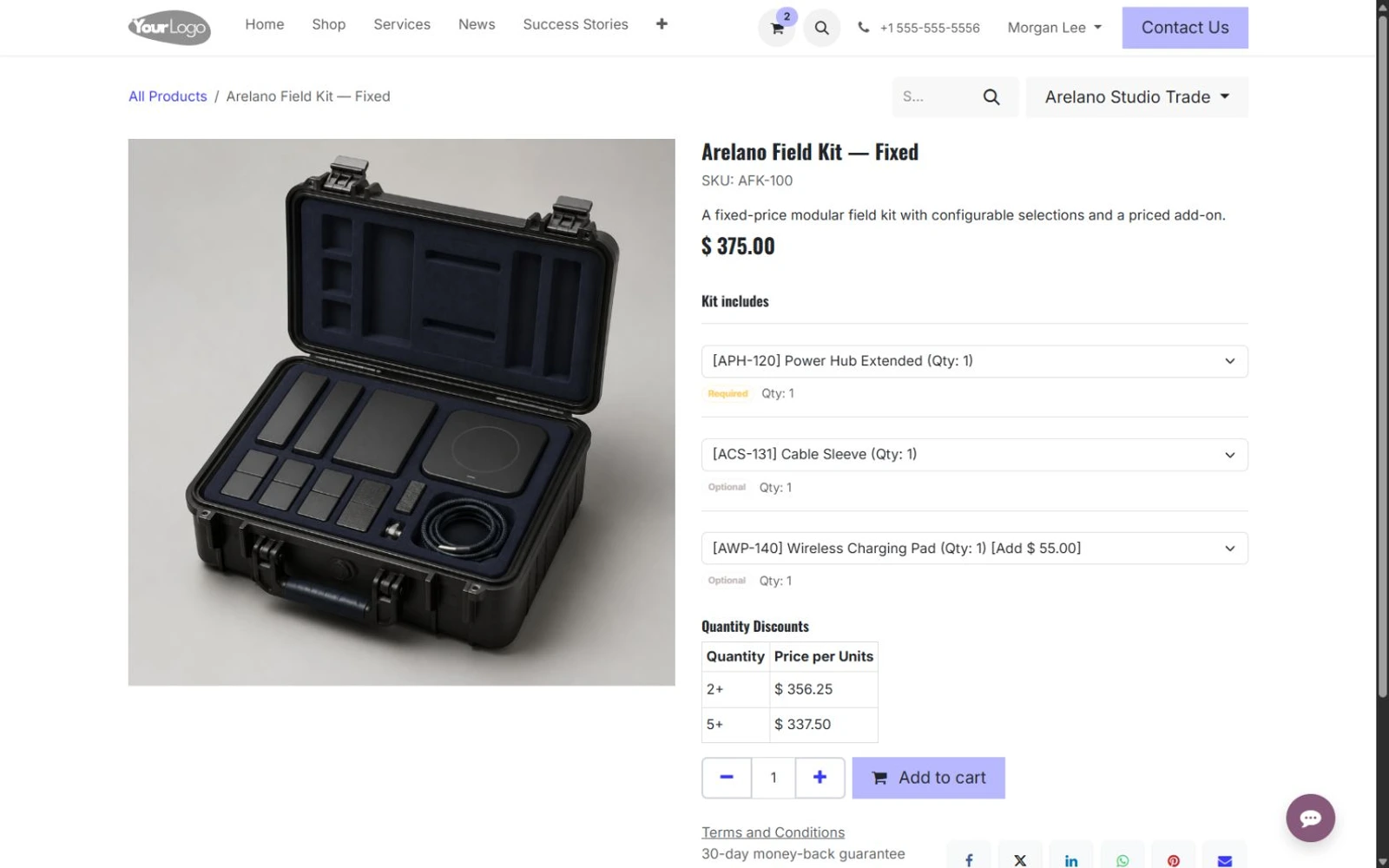
A shopper selects a fixed-price or component-sum kit, including required choices, substitutions, optional components, None selections, and priced add-ons.
- 02
Resolve price and retain identity
Odoo validates the selected options and resolves the applicable price on the server before the configured kit moves into the cart and quotation flow.
- 03
Carry the kit into fulfillment
The configured identity is retained through the sales order, delivery, and invoice while aliases consume the correct shared base inventory.
Implementation highlights
- A server-side pricing hierarchy with customer-specific pricing and quantity discounts.
- Product aliases with separate SKUs and selling units of measure that consume shared base inventory.
- Fixed-price and component-sum configurable kits with required selections, substitutions, optional components, None selections, and priced add-ons.
- Configured-kit identity preserved from the website cart through quotation, sales order, delivery, and invoice.
- Validated option access and server-side price resolution for a portal-safe configuration experience.
Testing & validation
- Fixed-price and component-sum kit scenarios resolve to $375 USD and $280 USD respectively in the synthetic demo.
- Field Kit ×2 resolves to $712.50 after a 5% discount; Signal Cable Pack ×3 resolves to $256.50 after 5% while consuming 18 base units.
- A complete synthetic demo order carries a $1,249 USD total from cart through the final documents.
- Regression checks cover portal access, server-side option validation, price resolution, and configured-kit continuity.
Outcome / current status
A portfolio-safe Odoo 18 Commerce implementation that keeps price resolution server-side and carries each configured kit from the storefront through delivery and invoicing. All products, customers, prices, images, and order documents shown are synthetic.
Tech stack
- Odoo 18 Community
- Python
- PostgreSQL 15
- Docker
- Git/GitHub
05 · Screenshot gallery
Interface evidence from the independent Odoo 18 Community project. Every displayed product, customer, price, and document is synthetic.
The workflow, from storefront to invoice.
Screenshot 1 of 10